It’s no secret: We love trains.
And yes, we love spending the weekend chatting with fellow railfans as the trains rumble by our front porch at The Station Inn, but we also enjoy model railroads.
We’re not just talking about the classic Lionel model trains that wrapped around your parent’s Christmas tree while you were growing up.
We’re talking about those lovingly handcrafted miniature worlds that capture everything that’s exciting in the world of trains.
Believe us: We’ve spent countless hours tinkering away. But we often hear the same question from new railfans and casual observers: How the heck did you make that?!
Well, we’ve got you covered. In this article, we’re diving into the nuanced steps behind how to make a model railroad—especially one that’s uniquely you.
Table of Contents
Before You Get Started: 4 Questions to Ask
How to Make A Model Railroad Layout: Tips & Tricks For Every Stage
See The Trains Up Close At The Station Inn
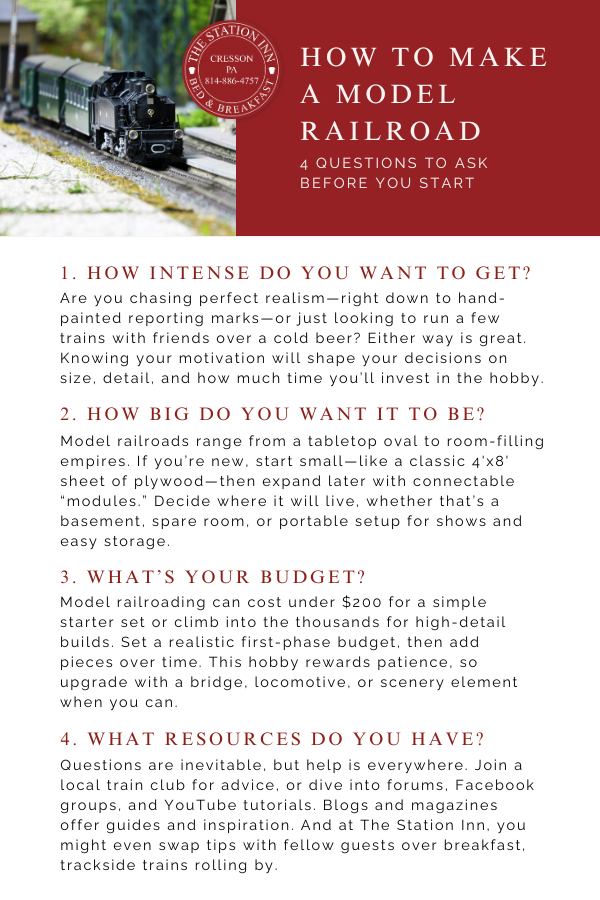
Before You Get Started: 4 Questions to Ask
Building a model train set is a little like eating an elephant: You have to do it one bite at a time.
Before diving into the wild, wonderful, and relaxing hobby of model railroading, consider these questions behind how to make a model railroad:
1. How Intense Do You Want to Get?
What’s your driving force in jumping into model railroads?
Are you excited about obsessing over the font choice for your hand-painted reporting marks, or are you simply looking forward to assembling a few trains while drinking beers with a couple of buddies in your basement?
Either option is great (and we’ll admit we do a bit of both), but understanding where your head is at is an important framework for answering the rest of the questions on this list.
2. How Big Do You Want It to Be?
Model railroads can span a single tabletop or your entire garage—and potentially even creep into your spouse’s craft room if you’re not careful.
If you’re new to the hobby, starting small has its advantages. A 4’x8′ sheet of plywood is a classic beginner’s canvas. You can always expand later by building additional “modules” that connect together—perfect if you want to grow your layout as your skills and budget expand.
Before you commit, think about where your railroad will live. Basements, attics, and spare rooms are popular choices, but some modelers build portable layouts they can set up for shows or tuck away when not in use.
Tip: There are even clubs for these portable “modules” that form a larger layout. Here’s one example: https://free-mo.org/
Of course, this also drives a key question: What scale do you want to model? Trains are available in teeny-tiny Z scale all the way up to the garden-size G scale. Your grandpa’s Lionel trains are O scale, the smaller HO is the most common scale out there (think Tyco or Bachman trains from the 70s and 80s), and N scale is the second most common and allows you to fit quite a bit onto a 4×8 sheet of plywood.
3. What’s Your Budget?
Model railroading can be as affordable—or as wallet-draining (believe us)—as you make it. Globally, fans spend about $1.2 billion every year on model railroading, and, as this Reddit thread shows, large-scale builds can cost tens of thousands of dollars over multiple years.
Of course, you don’t have to spend nearly that much.
You can start simple with a basic locomotive, a few cars, and an oval of track for under a couple hundred dollars. Or, if you’ve got deeper pockets, you can spring for high-detail engines, sound decoders with a basic Digital Command Control (DCC) controller, hand-weathered freight cars, and realistic scenery that would make a Hollywood set designer jealous.
A good approach is to set a total budget for your first phase of building, then see how far that budget gets you. And remember, you don’t have to buy everything at once—this is a hobby built on patience and long-term enjoyment.
There’s nothing wrong with adding a new bridge or switching locomotives as a birthday treat or holiday present. (Which reminds us: Check out our article on 27 gifts for train lovers.)
You can definitely find great used models for relatively modest investments at train shows and eBay.
4. What Resources Do You Have?
No matter how much experience you have, questions are going to pop up. (“Why won’t this turnout throw?” “Wait—do I glue ballast before or after painting the track?” “Is this tunnel portal tall enough for my double-stack container cars, or am I about to invent the world’s shortest intermodal train?”) The good news: the model railroading community is huge, friendly, and eager to help.
Look for a local train club where you can swap tips and maybe even get some hands-on help with tricky wiring or scenery techniques. Online forums, Facebook groups, and dedicated YouTube channels can walk you through almost any challenge you’ll face.
And don’t forget blogs and magazines! Many are full of step-by-step guides and inspirational layouts to keep you motivated. And if you stay at The Station Inn, you might just find a fellow guest or two ready to share their best tricks over breakfast.
How to Make A Model Railroad Layout: Tips & Tricks For Every Stage
Before you embark on building your own model railroad layout, check out our overview of tips for every section of your design:
Building Terrain
Think of terrain as the canvas your trains will run on. Foam insulation board, plaster cloth, and/or crumpled newspaper covered in scenery material can give you rolling hills, river valleys, and mountain passes.
Tip: Start with gentle slopes rather than steep cliffs, as it’s easier to blend scenery and make it look realistic. And always leave access points so you can reach any spot without crawling on your layout like a mountain goat.
Laying Track
Trackwork is the backbone of your railroad. Whether you use sectional track or flex track, take your time here; a smooth, level line will save you headaches later.
Tip: Lay cork or foam roadbed under the rails for a more realistic look and quieter operation. Test your curves with your longest cars before fixing the track in place—tight turns might look fine until your passenger cars derail. If you’re starting out basic or small, we recommend Kato Unitrak for N or HO scale. It looks good and works very well.
Building Scenery
This is where your layout comes to life. Use ground foam, static grass, and trees to transform your plywood empire into a miniature landscape.
Tip: Vary your colors and textures—real nature isn’t one shade of green. Mixing materials (like blending fine turf with coarse) will make your scenery pop. And don’t be afraid to use “forced perspective” by placing smaller trees or buildings in the background to make your layout feel bigger.
Adding the Details
Little touches turn a good layout into a great one. Add figures, vehicles, trackside signs, and small scenes that tell a story—a farmer loading hay bales, a mechanic fixing a truck, or kids fishing by a pond.
Tip: Keep a few “Easter eggs” hidden in your scenery for visitors to discover. They might spot a deer in the trees, a dog chasing a mailman, or, if it’s your spouse, a miniature of themselves patiently indulging your new favorite hobby.
Adding Structures
Stations, factories, houses, and bridges are the landmarks of your layout. You can buy prebuilt kits, assemble plastic models, or scratch-build from wood and styrene—whatever you’re most comfortable with.
Tip: Weather your structures with paint washes, weathering powders, or chalk to tone down that “fresh-out-of-the-box” shine. Even the cleanest buildings pick up a little grit and rust near the tracks!
See The Trains Up Close At The Station Inn
We love model trains as much as the next person, but even we enjoy stepping away every now and then to see them up close, and the legendary front porch of The Station Inn is the perfect place to make that happen.
Approximately 50 trains roll by every day—on the same tracks that run along the Horseshoe Curve.
Book a room at our Cresson, PA B&B for an unforgettable train-themed getaway!