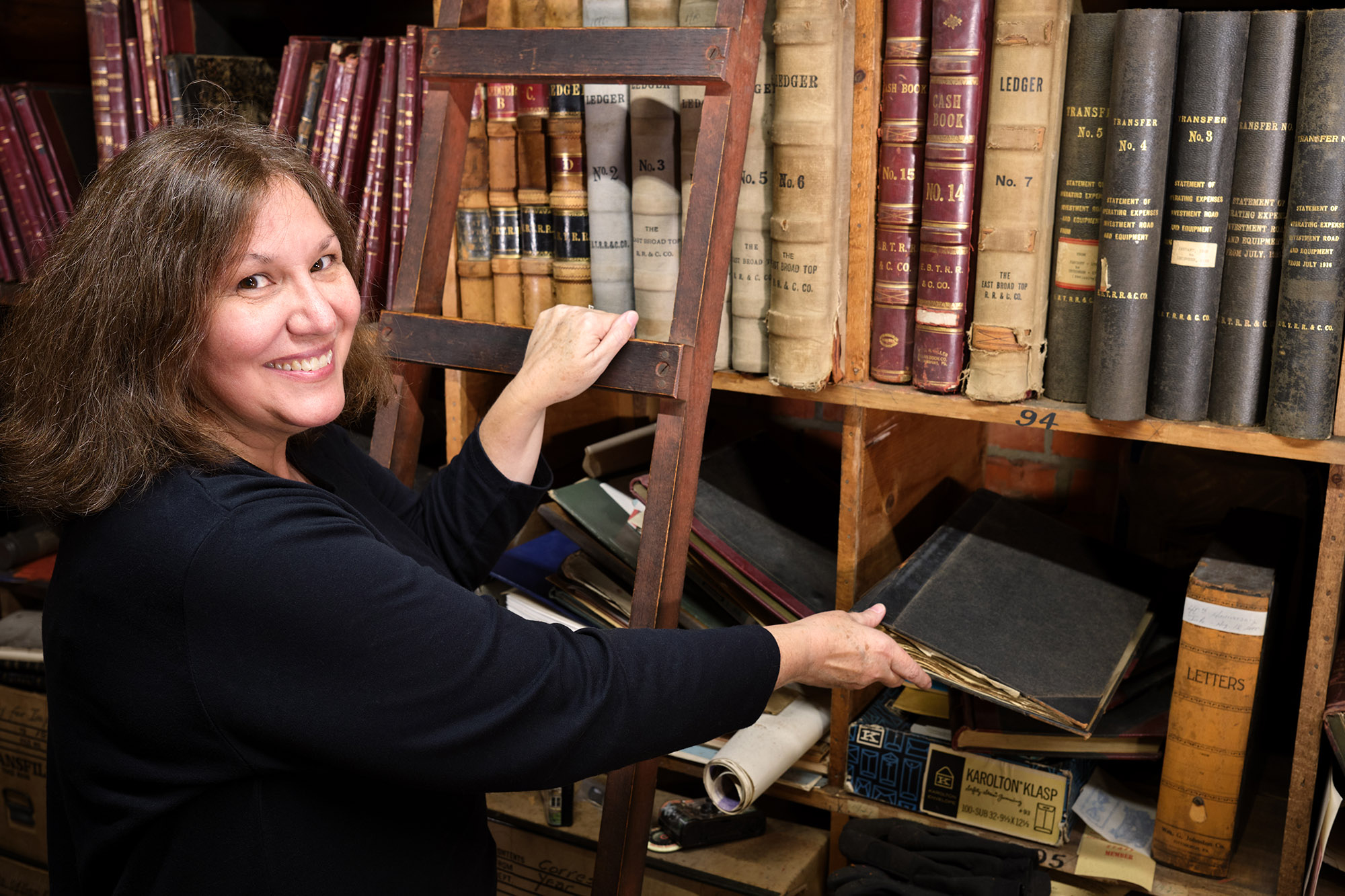
The definitive volume, The Railroad and the Art of Place: An Anthology (2021), published by the Center for Railroad Photography & Art, showcases the work of 25 contemporary photographers who depict various perspectives on today’s railroad landscape. The anthology also celebrates noted artists and photographers of the past known for their exploration of railroad scenery.
During my first residency stay at The Station Inn in June, I revisited the anthology, determined not only to examine the fantastic images but also to delve into the minds of these photographers and scholars to understand why the railroad landscape and photographing it resonate with me so profoundly. The opening sentence of North Dakota photographer Lewis Ableidinger’s dynamic essay packed a powerful punch:
“IN HIS BOOK WOLF WILLOW WALLACE STEGNER WROTE, ‘Expose a child to a particular environment at his susceptible time and he will perceive in the shapes of the environment until he dies.’” (p. 29)
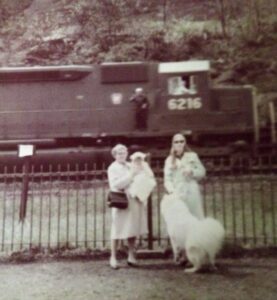
Stegner’s words took me back to a specific family photograph, which I’ve titled ‘My First Train.’
Born in Johnstown, Pa., at Mercy Hospital on December 6, 1967, I grew up in nearby Ebensburg where the Cambria and Indiana Railroad (C&I) and the Ebensburg and Black Lick Railroad, a former Pennsylvania Railroad branch line, ran through the southern section of the quiet, little town atop the verdant Alleghenies.
My father, Joseph J. Fether, Jr., an avid photographer, took numerous photos to commemorate every family experience, especially of the local industrial landscape he was familiar with, having worked as a mining engineer with Bethlehem Mines in the Cambria Division. I like to think that the picture he took at the Horseshoe Curve, of me as a baby being held by my grandmother, Susanna Fiel, with my mother, June Fiel Fether, and our Samoyed, Nicky, was my first train. Whether it was or not, this moment undoubtedly shaped my appreciation of the railroad landscape and its environs, building a lifetime of memories.
My reverence for railroad landscapes and photography led me to study the photographic works of William H. Rau and Michael Froio in 2014. Nineteenth-century Philadelphia photographer William Hermann Rau (1855-1920) is most recognized for his commission by the Pennsylvania Railroad to photograph the illustrious Main Line. In two trips starting in 1891, Rau traveled along the main line in his photographic car, producing a compelling and dramatic series of albumen prints to market the Standard Railroad of the World.
As I began to learn more about Rau, I came across professional photographer Michael Froio’s online blog entry, “William H. Rau: Using Historical Works for Artistic Guidance”(March 6, 2014, Field Notes). As I began reading, I sensed a deep connection between Rau’s and Froio’s photographs from his project, From the Main Line, an instant recognition as if all my memories of railroad and industrial landscapes had merged into a holistic vision, highlighting both the past and present simultaneously, especially with images of the beloved landscapes of and near my homeland.
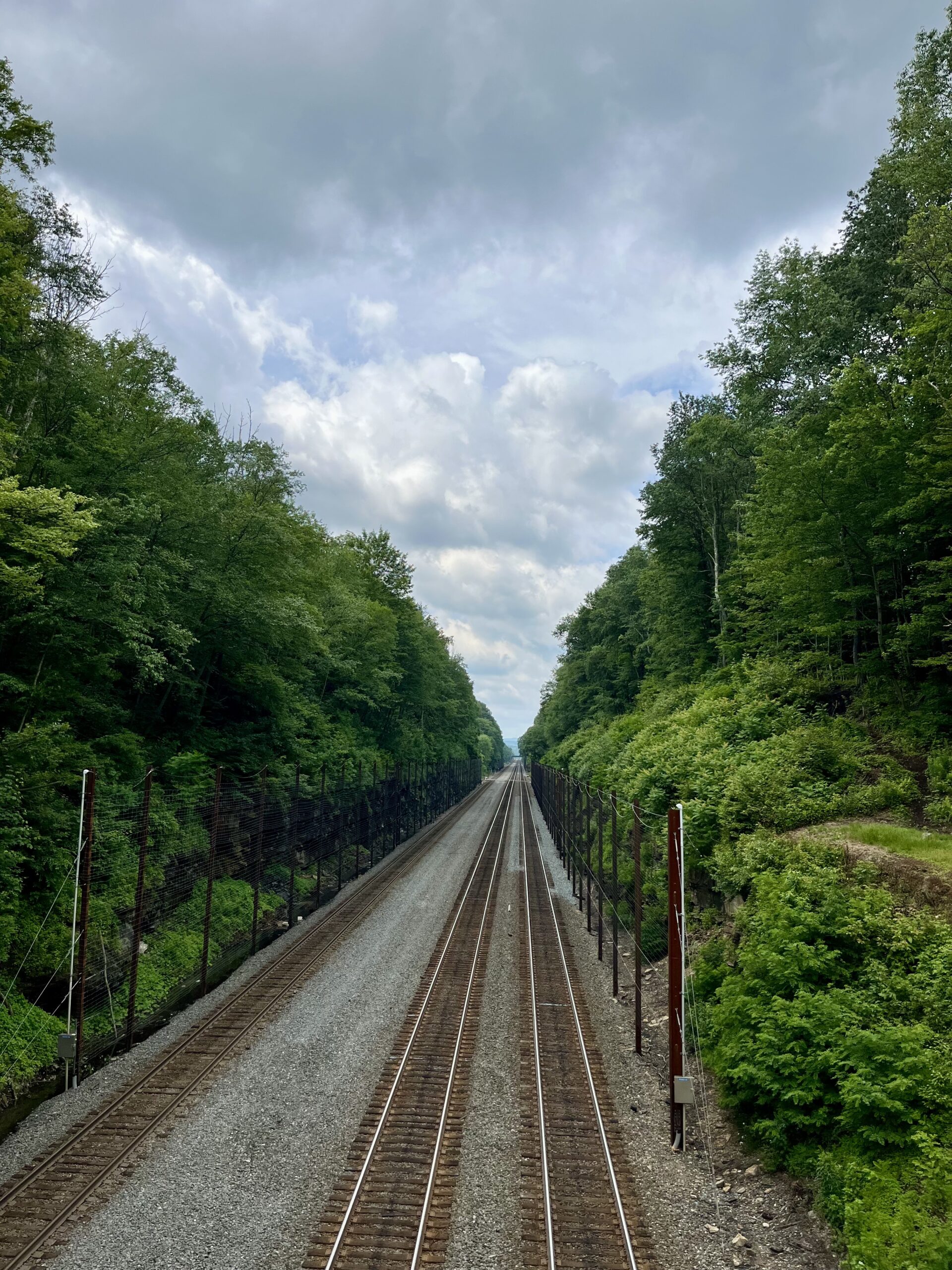
Most impressive to me are the series of Rau’s and Froio’s images capturing the heart of the Alleghenies, along the Juniata River, up and over Cresson Mountain, and extending into Johnstown. And it wouldn’t have been a residency stay in Cresson without relishing the landscapes where both Rau and Froio trekked and making the obligatory visit to the Cassandra Railroad Overlook. Rau’s and Froio’s photographs of this infamous, deepest cut on the main line do not disappoint.
Over a century between them, Rau’s and Froio’s crisp compositions aesthetically fuse the natural and railroad landscapes in a harmonic, theatrical tableau suspended in time and place. Imagine how many avid photographers and visitors have stood where Rau and Froio have been to capture images of the Cassandra Cut. I have been one of them multiple times, and the scene never gets old.
Our relationship to landscapes and memory is a part of living, but we can also create “landscapes of the mind” (Schama, 1995), where a perceived landscape affords us imagination. Both are critical to understanding where we came from and how we relate to and interpret the inevitable transformations of the landscape that occur over time, space, and place.
Both Rau’s and Froio’s photographs invite me to remember, imagine, and appreciate the landscape, for what it was and what it is today. For me, they evoke emotions and feelings related to longing. They humanize my connection to the landscape, the multi-layered rural, urban, natural, and industrial environments rolled up into one, a magically characteristic landscape, dramatically referred to as the Metropolitan Corridor.
Thanks, Dad, for taking a photo of my first train. Do you have your first train photo?
Sidetracks
Recommended reading and viewing:
Brouws, J., Craghead, A., Keefe, K., & Kahler, D. (Eds.). (2021). The Railroad and the Art of Place: An Anthology. Center for Railroad Photography & Art.
Mike Froio is one of the photographers featured in the anthology!
Froio, M. (2010-current) Field Notes. Michael Froio Photography. https://michaelfroio.com/blog
Rau, W.H. (1891-about 1905). Album of Pennsylvania Rail Road Scenery (cover title). Getty, Los Angeles, CA, United States. https://www.getty.edu/art/collection/object/104GNW
Schama, S. (1996). Landscape and Memory. Fontana Press.
Stilgoe, J.R. (1983). Metropolitan Corridor: Railroads and the American Scene. Yale University.
Van Horne, J.C. (Ed.) with Drelick, E.E. (2002). Traveling the Pennsylvania Railroad: The Photographs of William H. Rau. University of Pennsylvania Press.
“Atop the verdant Alleghenies” – refers to the opening lyric of the Central Cambria High School Alma Mater, Ebensburg, Pa., written by John Mason and set to the tune of “The Palisades.”
Ghost Town Trail: The Cambria & Indiana Railroad is currently an award-winning rails-to-trails path from Ebensburg to Blacklick, Pa., with additional extensions.
Cassandra Railroad Overlook ALL-NIGHTER 2025 – Saturday, August 2 – Sunday, August 3, 2025.
Photo Credits
Froio, M. (December 2023). Deep Cut looking west, Cassandra, Pennsylvania [Photograph]. Michael Froio.
*photo w/o snow
Froio, M. (December 2016). Deep Cut looking west, Cassandra, Pennsylvania [Photograph]. Michael Froio.
*photo with snow.
Cassandra Cut, William H. Rau. – Cuts West of Ben’s Creek; William H. Rau (American, 1855 – 1920); Pennsylvania, United States; about 1905; Gelatin silver print; 18.4 × 24 cm (7 1/4 × 9 7/16 in.); 84.XO.766.3.22
Cassandra Cut, Julie Fether Rockwell, June 20, 2025.

![Froio, M. (December 2016). Deep Cut looking west, Cassandra, Pennsylvania [Photograph]. Michael Froio.](https://stationinnpa.com/wp-content/uploads/2025/07/FroioM2.jpeg)
![Froio, M. (December 2023). Deep Cut looking west, Cassandra, Pennsylvania [Photograph]. Michael Froio.](https://stationinnpa.com/wp-content/uploads/2025/07/FroioM1.jpeg)