Look, we love railfanning as much as anyone else. We relish each opportunity to swap our favorite railfan stories with guests on our front porch overlooking the Norfolk Southern tracks, and we get a kick every time we pick up a new piece of railroad slang. But we’ll also be the first to tell you: Railfan safety is essential.
It’s not a laughing matter. As we’ll explore momentarily, hundreds of people die every year in the US from railroad-related catastrophes.
Yes, trains are stunning engineering marvels that have sparked passions like the photography of trains and even inspired our Artist-in-Residence Program—but they’re also incredibly dangerous.
Proper respect and understanding is necessary to maximize your enjoyment of the railroads without suffering an injury or fatality.
Use the table of contents to learn more.
Table of Contents
Train-Related Deaths & Injuries
Railfan Safety Rules & Best Practices
Stay Close to the Tracks—Without the Safety Risk
Train-Related Deaths & Injuries
Trains might be a source of joy for people like us, but they can also lead to heartbreaking deaths and life-changing injuries for those who don’t stay off the tracks, maintain a safe distance or observe safety precautions.
Some of the most surprising statistics:
- 2024 saw 2,261 railroad crossing-related accidents, with 262 fatalities and 763 injuries. (Source: Operation Lifesaver)
- 2024 saw a total of 6,452 railroad-related injuries and 954 railroad-related deaths, according to the National Safety Council.
- 626 trespassers suffered injuries in 2024, according to the National Safety Council.
- 663 trespassers died in 2024, according to the National Safety Council.
Railroad photographers also see their fair share of incidents. As photographer Bryan Esler writes in Photofocus, more than 20 Americans have been killed or injured in rail-and-photography-related incidents since 2011.
Sadly, virtually all of these incidents were preventable. With the proper precautions and railfan safety measures, fellow railroad lovers can remain safe on each trip—regardless of whether they’re approaching a railroad crossing in a car or stepping up close for the perfect photo op.
Railfan Safety Rules & Best Practices
As they say in countless workplace safety trainings around the country: Safety is no accident. As a railfan, you’re responsible for making responsible, intentional decisions that protect the safety of yourself and fellow members of your party.
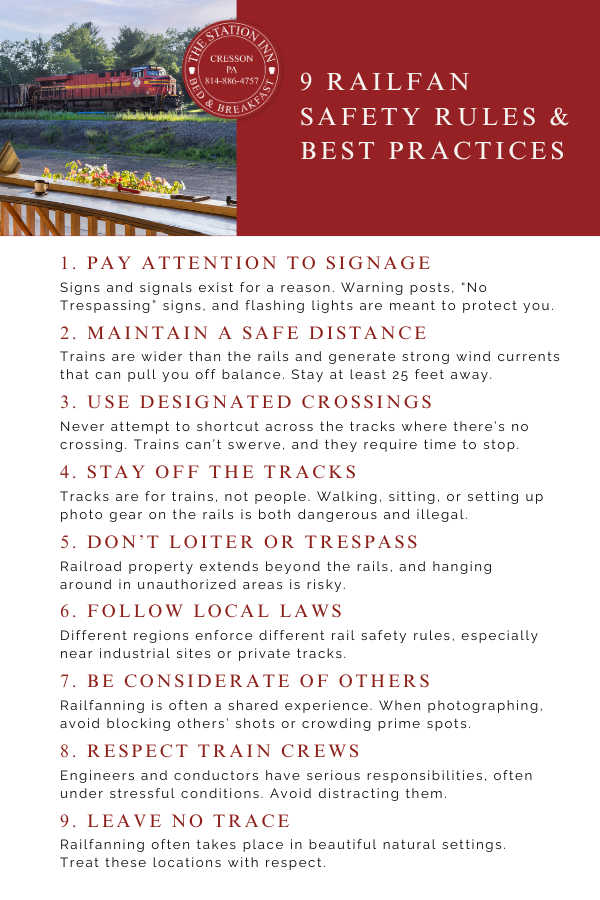
Here are some of the most important railfan safety rules to follow:
1. Pay Attention to Signage
Signs and signals exist for a reason. Warning posts, “No Trespassing” placards, and flashing lights at crossings are meant to protect you. Treat them seriously, even if the tracks appear quiet. Trains can approach faster and more silently than expected—not all trains are heavy freight trains.
Following posted rules keeps both railfans and train crews safe.
2. Maintain a Safe Distance
Trains are wider than the rails and generate strong wind currents as they pass. Standing too close can pull you off balance—or worse—thanks to a phenomenon known as Bernoulli’s Principle, where a fast train can literally suck you into it
Always remain at least 25 feet from the track, even if you’re just taking a quick photo. A safe buffer ensures your railfan memories don’t come with regrets.
3. Use Designated Crossings
Never attempt to shortcut across the tracks where there’s no crossing. Trains can’t swerve, and they require long distances to come to a “sudden” stop. Designated crossings are designed with visibility and safety in mind. A few extra minutes walking to the right spot can prevent a lifetime of consequences.
Remember: As the Operation Lifesaver data pointed out earlier, there are thousands of accidents at railroad crossings every year.
4. Stay Off the Tracks
Tracks are for trains, not people. Walking, sitting, or setting up photo gear on the rails is both dangerous and illegal. Many accidents happen because people underestimate how quickly a locomotive closes distance. Keep yourself—and your equipment—off the rails at all times to protect your life and hobby.
If you’re not convinced, consider this: A commonly cited rule states that a 6,000-ton train travelling at 60 miles per hour takes about a mile and a half to stop in an emergency. That means for a train crew to avoid hitting you on the tracks, they need to see you and apply the brakes at least 1.5 miles away.
Take a look out your window and imagine someone standing nearly two miles away. How easy would it be to see them?
5. Don’t Loiter or Trespass
Railroad property extends beyond the rails, sometimes much further than 25 feet away. Hanging around in unauthorized areas is risky. Industrial yards, maintenance zones, and bridges are off-limits for a reason. Trespassing not only endangers you but also puts rail crews at risk. Always respect property boundaries.
Plus, as we mentioned earlier: Trespassing often leads to railroad fatalities and injuries. Here’s the tally over the last few years, according to the National Safety Council:
- 2024 – 663 deaths, 626 injuries
- 2023 – 690 deaths, 656 injuries
- 2022 – 601 deaths, 549 injuries
- 2021 – 578 deaths, 533 injuries
- 2020 – 506 deaths, 556 injuries
6. Follow Local Laws and Regulations
Different regions enforce different rail safety rules, especially near industrial sites or private tracks. Always research local ordinances before heading out. Railroads often prohibit non-employees from certain areas. Ignorance isn’t an excuse—and staying compliant keeps you safe while protecting the reputation of the broader railfan community.
7. Be Considerate of Others
Railfanning is often a shared experience. When photographing, avoid blocking others’ shots or crowding prime spots. Set up equipment where it won’t interfere with others. A spirit of courtesy makes the experience better for everyone, creating the kind of camaraderie we love to see on The Station Inn porch.
8. Respect Train Crews
Engineers and conductors have serious responsibilities, often under stressful conditions. Avoid distracting them with signals, lasers, or unnecessary gestures. A wave from a safe distance is fine, but don’t try to flag trains down or stop railworkers while they’re working.
Respecting their work ensures smoother operations and builds goodwill between fans and railroad professionals.
9. Leave No Trace
Railfanning often takes place in beautiful natural settings. Treat these locations with respect: pack out trash, avoid trampling plants, and don’t damage fences or infrastructure. A “leave it better than you found it” mindset ensures future fans can enjoy the same locations without added restrictions or environmental harm.
Stay Close to the Tracks—Without the Safety Risk
Come stay close to the railroading action at The Station Inn! Live a true railfan’s dream by standing face-to-face with the best trains in Pennsylvania as they pass right by our front porch—no safety risks involved!
Learn more about us or book a room now.
General Safety Note: While you can stay close to the trains at The Station Inn, you shouldn’t get close to the trains or tracks! You should always stand at least 25 feet away from the tracks to maintain a safe distance.