I share a lot in common with my fellow railfans. In fact, if you see me chasing after a train, there’s a good chance you’ll see my camera in tow. I love train photography.
I’ve actually shared photos on this blog in the past—in 20 Cylinders On the East Slope, Conrail’s Summit of the Alleghenies, and others. And while I’m passionate about capturing that perfect shot, I’m equally passionate about railroad safety for photographers.
The reason is simple: There’s no joy in capturing incredible train photos if it leads to an injury—or worse.
So, while we’ve covered railfan safety in the past, it’s time to get even more focused.
Let’s talk about the rules of railroad safety for photographers.
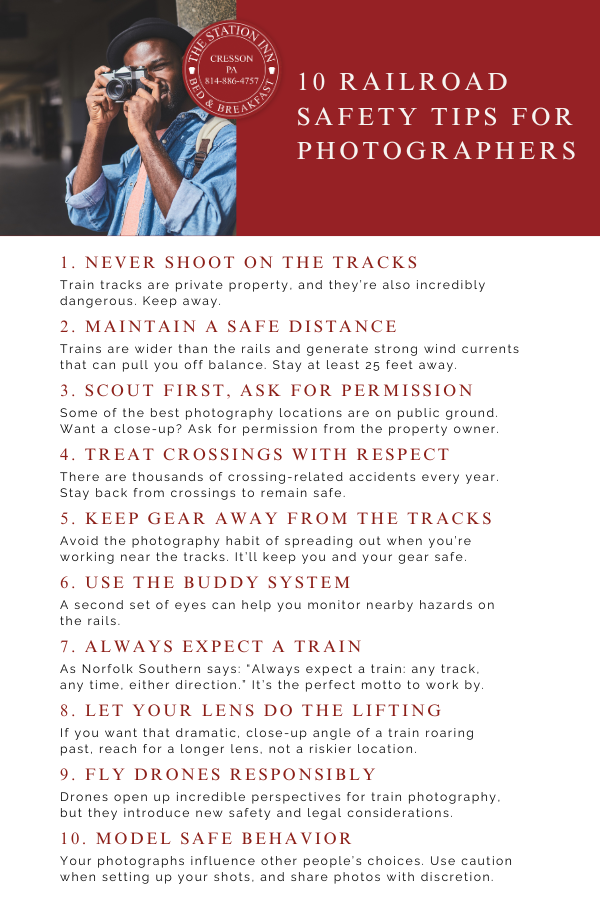
10 Safety Tips for Railroad Photographers
We’ve all heard that old Boy Scout motto: “Be prepared.”
Prepare for your next photography trip by reviewing these safety tips—and focus on turning them into lifelong habits.
1. Never Shoot on the Tracks
We’ll start with the big one: Tracks are private property, not an invitation to fill up your memory card.
Railroad tracks—active or “abandoned”—belong to the railroad, and walking or setting up on them is considered trespassing in most states.
But this is about more than the legal risk. Stepping onto the tracks is dangerous. Trains can move faster and more quietly than you expect, and they can’t swerve to avoid you—and they often take a full mile to come to a complete stop.
Fatalities happen more than you may realize; the Federal Railroad Administration says there’s more than 500 trespass-related deaths every year.
If a shot requires someone standing on the rails, it’s not a shot worth taking. Even if you have a great idea for a group photo with your railfanning friends or for a lovely senior portrait for your niece, stay off the tracks.
2. Maintain a 25-Foot (or More) Safety Buffer
A good rule of thumb you’ll see from safety advocates: Stay at least 25 feet away from the nearest rail. And it’s not just the train you’re protecting yourself from.
Some additional benefits of staying 25+ feet away:
- Debris can kick up from under the wheels, turning trash and pebbles into deadly projectiles. Plus, bands, straps, and tie-downs can come loose and whip off of railcars. Your distance keeps you safe.
- Fast-moving passenger trains create strong air currents, and these can pull you onto the tracks and under the wheels. Extra distance means the currents won’t impact you.
- The gravel and ground around the tracks can be uneven and slippery, and you could risk slipping or falling. Keeping your distance keeps you on stable ground.
Do yourself a favor: Stay back from the track.
3. Scout First, And Ask Permission When Needed
Some of the best train photos in the world are taken from public vantage points:
- station platforms
- sidewalks
- park trails
- road bridges
- scenic overlooks
You’ll find these in abundance throughout Pennsylvania and the rest of the country.
If you’re tempted by a particular location that appears to be on private or railroad property, track down the property owner and ask. But be warned: Many railroads restrict access to non-employees altogether for safety and liability reasons.
When in doubt, move to a safer, clearly public spot and let the trains come to you.
4. Treat Crossings Like the Dangers They Are—Not Like A Stage
Grade crossings might look like ready-made photo sets, but they’re some of the most dangerous spots you can choose to shoot.
In 2024 alone, railfans suffered 2,261 railroad crossing-related accidents, according to Operation Lifesaver. Think about that for a moment: A little distance and a dash of common sense could have prevented thousands of life-threatening incidents.
To remain extra safe, never set up:
- On the roadway next to a crossing
- On the shoulder next to a crossing
- Between the gates at a crossing
- On the tracks at a crossing
It’s tempting, sure, but it’s not worth the risk.
5. Keep Your Gear Clear of the Tracks
As photographers, we tend to spread out—tripods here, bags there, lighting gear on the ground. Near railroad tracks, that’s a bad habit.
Keep all gear well outside the 25-foot buffer. Never lay a tripod across the rails or balance a camera on the track.
Instead, find a stable, level area for your gear. Use straps, harnesses, or clips so nothing swings unexpectedly into your path when a train approaches.
6. Use the Buddy System
You should always take a friend with you into remote areas, but it’s even more important when you’re shooting along a busy main line or in a new location. A second set of eyes can:
- Watch for trains approaching from either direction
- Monitor traffic at crossings or on nearby roads
- Help you avoid backing into hazards
Agree ahead of time on simple verbal cues or hand signals so everyone knows what to do when a locomotive appears. Think of your spotter as another essential part of your kit.
7. ‘Always Expect A Train: Any Track, Any Time, Either Direction.’
Tip seven comes directly from Norfolk Southern’s recent What you need to know to stay safe around trains and tracks article.
Modern locomotives and welded rail can make trains surprisingly quiet until they’re very close. If you’re wearing headphones, staring at a screen, or chatting with a friend, it’s easy to miss the subtle cues that something’s approaching.
Build the opposite habit: Pause periodically, step back, and take a full look and listen up and down the line. Treat every track as live, even if you “never see anything there.”
8. Let Your Lens Do the Heavy Lifting
If you want that dramatic, close-up angle of a train roaring past, reach for a longer lens, not a riskier location.
A telephoto lens lets you compress distance, fill the frame, and capture detail—all while staying safely back from the right-of-way. Wide-angle lenses, meanwhile, can be fantastic from elevated or side-on vantage points where you have plenty of room.
If a composition forces you closer than your safety comfort zone, reframe elsewhere. There’s always another angle.
9. Fly Drones Responsibly Near Trains
Drones open up incredible perspectives for train photography, but they introduce new safety and legal considerations. To remain safe:
- Follow FAA rules and local laws, including registration and airspace restrictions where required.
- Maintain visual line-of-sight and avoid hovering directly above tracks, trains, or people.
- Keep a generous horizontal distance so a sudden loss of control doesn’t send your drone into the right-of-way.
As our friend Craig Hensley likes to point out, drones are powerful tools—but they come with responsibilities. Use them to extend your safe vantage point, not to justify risky flying.
10. Model Safe Behavior in the Photos You Share
Like it or not, the photos we post influence other people’s choices.
When photographers publish images of trains approaching on the rails or clients walking down the tracks, it normalizes illegal and dangerous behavior.
Do your part by leading with safe images: shots taken from public platforms, overlooks, parks, and other clearly safe vantage points. If someone asks for a track photo, use it as a teaching moment—and suggest a better, safer alternative.
Stay Close to the Tracks
Get even closer to the action at The Station Inn! Our front porch overlooks four active Norfolk Southern rails—the same ones that run along the historic Horseshoe Curve.
Book a room today!